
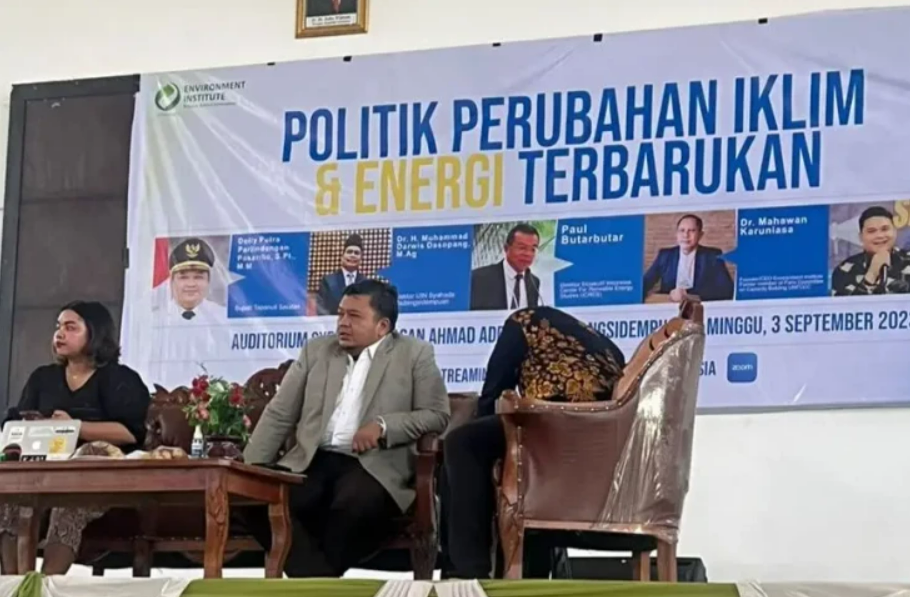
SOUTH TAPANULI – The Batangtoru Hydroelectric Power Plant (PLTA) currently being built by the government in Sipirok Village, South Tapanuli (Tapsel), North Sumatra, is considered to have a positive impact on the community. It not only meets the electricity needs of North Sumatra residents but also has a significant economic impact. Latip Kahpi, an academic at the Syahada State Islamic University (UIN) Padangsidempuan, believes the Batangtoru Hydroelectric Power Plant (PLTA) is a concrete manifestation of Indonesia’s transition to clean energy.
“The Batangtoru Hydroelectric Power Plant (PLTA) has had a significant economic impact. It has now absorbed hundreds of new workers from the Tapsel (South Tapanuli) community,” Latip said in a Political Discussion on Climate Change and Renewable Energy held by the Environmental Institute in Padang Sidempuan, Sunday (September 3, 2023).
He stated that the Batangtoru Hydroelectric Power Plant, with a capacity of 510 MW (4×127.5 MW), also addresses the needs of hundreds of thousands of residents who have not had access to electricity. Latip added that currently, 65,000 households, or around 300,000 people, in North Sumatra still do not have access to electricity. Electricity is a basic need that must be met.
“The impact of the Batangtoru Hydroelectric Power Plant is enormous. We support its immediate operation to meet the electricity needs of the entire North Sumatran community,” he said. Latip also believes the Batang Taro Hydroelectric Power Plant will not only create jobs but also positively impact agriculture in the South Tapanuli region.
“The Batangtoru hydroelectric power plant will also improve environmental sustainability. When forests are damaged, water flow is disrupted, ultimately reducing the water supply used to produce energy sources,” he said.
From an Islamic perspective, Latip added, energy is no longer a secondary need, but has become a primary need. This is because almost all human activities require energy. “Islam views energy as no longer a pilgrimage, but rather a necessity, meaning that the increasing need for energy in the modern era has made renewable energy a basic human need,” he said.